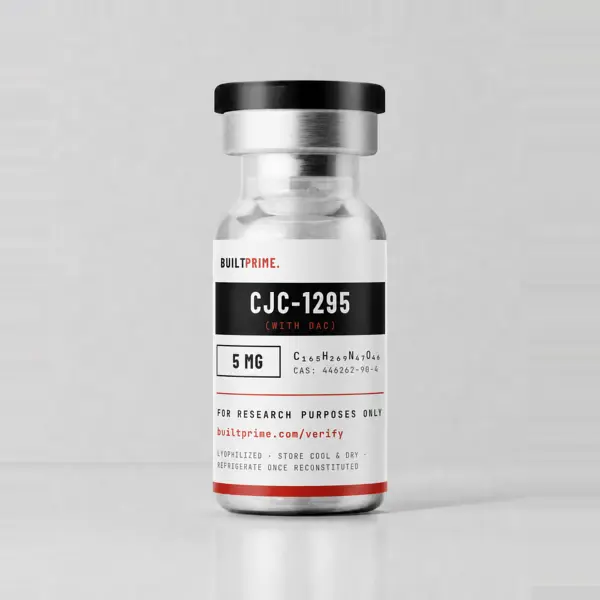
A modified GHRH analog conjugated with a Drug Affinity Complex that binds albumin, extending its half-life to 6 – 8 days for sustained growth hormone elevation.
Last updated: October 2026 · Editorial Policy
CJC-1295 with Drug Affinity Complex (DAC) is a long-acting synthetic GHRH analog. It shares the same modified GRF (1-29) core as the No DAC version, but is conjugated with a reactive lysine linker called the Drug Affinity Complex. Once injected, this DAC moiety covalently bonds to circulating albumin, shielding the peptide from enzymatic degradation and extending its effective half-life from ~30 minutes to 6 – 8 days.
This produces a fundamentally different GH release pattern compared to the No DAC variant: instead of short, intense pulses, CJC-1295 (DAC) creates a sustained, steady-state elevation of growth hormone and IGF-1 levels throughout the week. This makes it the more convenient option for researchers who prefer less frequent dosing.
CJC-1295 (DAC) activates the same GHRH receptor pathway as endogenous GHRH and the No DAC variant, but its albumin-binding property changes the pharmacokinetic profile entirely:
CJC-1295 (DAC) is administered once or twice weekly via subcutaneous injection. Its long half-life means precise timing is less critical than with the No DAC variant:
| Protocol | Dose | Frequency | Notes |
|---|---|---|---|
| Standard | 2 mg | Once weekly | Steady-state GH elevation |
| Aggressive | 2 mg | Twice weekly | Higher sustained IGF-1 |
Inject subcutaneously in the abdomen or thigh. Unlike the No DAC version, timing relative to food is less critical due to the sustained release profile. Typical research cycles run 8 – 12 weeks.
Supplies: peptide vial, bacteriostatic water, insulin syringes (29–31 gauge), alcohol swabs.
Concentration: 2 mg in 2 mL = 1,000 mcg/mL
Typical research cycle: 8–12 weeks. Results generally reported within 2–4 weeks.