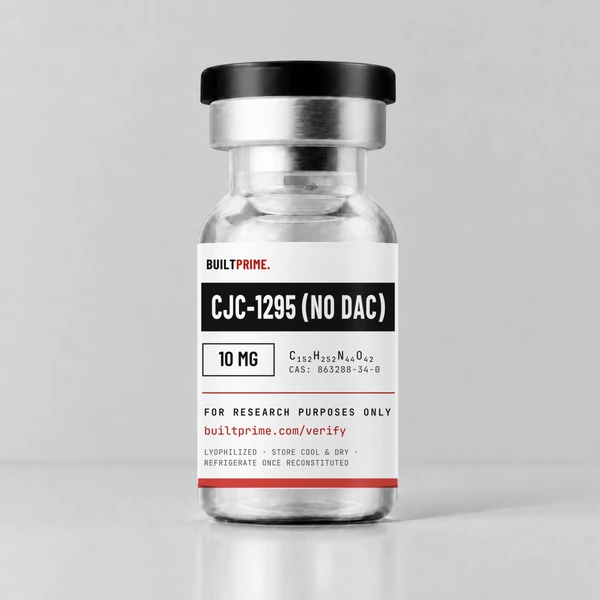
A modified fragment of growth hormone-releasing hormone with four amino acid substitutions for enhanced stability and short-acting, pulsatile GH release.
Last updated: October 2026 · Editorial Policy
CJC-1295 without Drug Affinity Complex (No DAC), also known as Modified GRF (1-29), is a synthetic analog of the first 29 amino acids of growth hormone-releasing hormone. Four amino acid substitutions at positions 2, 8, 15, and 27 protect it from rapid enzymatic degradation, extending its functional half-life from under 10 minutes to approximately 30 minutes.
Unlike the DAC version which binds to albumin for extended circulation, the No DAC variant produces short, intense GH pulses that closely mimic the body's natural secretion pattern. This makes it the preferred research variant for preserving physiological GH rhythms.
CJC-1295 (No DAC) acts on the same GHRH receptor pathway as endogenous GHRH, but with greater resistance to DPP-IV enzymatic cleavage. Key mechanisms include:
CJC-1295 (No DAC) is administered via subcutaneous injection 2 – 3 times daily, typically before meals and at bedtime. The protocol below reflects commonly reported research dosing:
| Protocol | Dose | Frequency | Notes |
|---|---|---|---|
| Standalone | 100 mcg | 2 – 3x daily | Before meals or at bedtime |
| With Ipamorelin | 100 mcg each | 2 – 3x daily | Combined injection, synergistic |
| Pre-bed pulse | 100 – 200 mcg | Once nightly | Amplifies nocturnal GH surge |
Inject subcutaneously on an empty stomach. Avoid eating for 20 – 30 minutes post-injection to prevent insulin-mediated GH blunting. Typical research cycles run 8 – 16 weeks.
Supplies: peptide vial, bacteriostatic water, insulin syringes (29–31 gauge), alcohol swabs.
Concentration: 2 mg in 2 mL = 1,000 mcg/mL
Typical research cycle: 8–12 weeks. Results generally reported within 2–4 weeks.