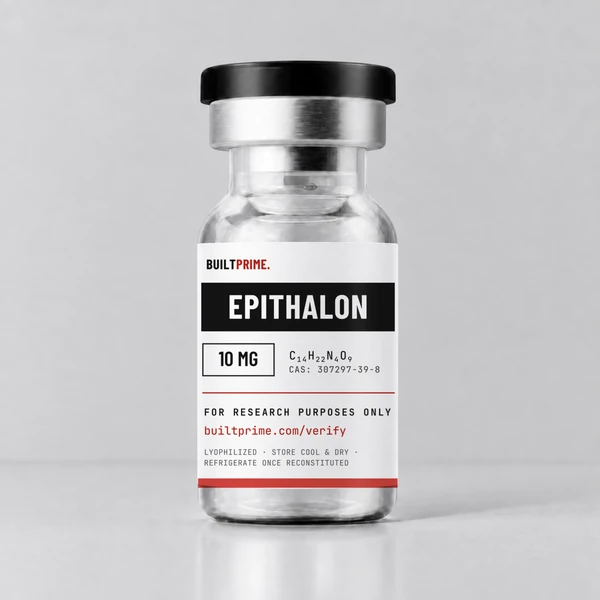
Synthetic tetrapeptide (Ala-Glu-Asp-Gly) for telomerase activation, circadian rhythm regulation, and anti-aging research.
Last updated: October 2026 · Editorial Policy
Epithalon (also spelled Epitalon) is a synthetic tetrapeptide with the sequence Ala-Glu-Asp-Gly (AEDG). Developed by Professor Vladimir Khavinson at the St. Petersburg Institute of Bioregulation and Gerontology, it is a synthetic analog of Epithalamin, a polypeptide naturally produced by the pineal gland.
Epithalon is best known for its ability to activate telomerase, the enzyme responsible for maintaining and lengthening telomeres – the protective caps on the ends of chromosomes. Telomere shortening is one of the hallmarks of cellular aging, making Epithalon one of the most studied peptides in anti-aging research.
Epithalon’s primary mechanism involves stimulating the production of telomerase in somatic cells. By reactivating this enzyme, it may allow cells to replicate beyond their normal Hayflick limit, effectively extending cellular lifespan in research models.
As a pineal gland bioregulator, Epithalon has been shown to restore melatonin production in aged animal models, helping normalize circadian rhythms and sleep architecture that typically deteriorate with age.
Like other Khavinson peptides, Epithalon is theorized to interact with DNA at the epigenetic level, modulating the expression of genes involved in antioxidant defense, apoptosis regulation, and cellular repair mechanisms.
| Protocol | Dose | Frequency | Duration |
|---|---|---|---|
| Standard Anti-Aging | 5–10mg | 1x daily | 10–20 days |
| Intensive Cycle | 10mg | 1x daily | 20 days |
| Maintenance | 5mg | 1x daily | 10 days every 4–6 months |
Epithalon is typically administered in short cycles of 10–20 days, repeated every 4–6 months. This mirrors the pulsatile dosing pattern used in Khavinson’s original clinical research.
Supplies: peptide vial, bacteriostatic water, insulin syringes (29–31 gauge), alcohol swabs.
Concentration: 10 mg in 2 mL = 5,000 mcg/mL
Typical research cycle: 10–20 day cycles. Results generally reported within Varies.