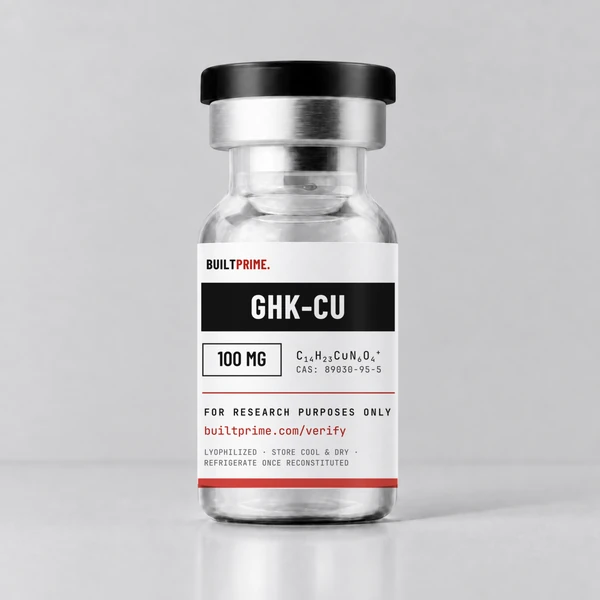
Naturally occurring copper complex (Gly-His-Lys·Cu) for skin remodeling, wound healing, collagen synthesis, and anti-aging research.
Last updated: October 2026 · Editorial Policy
GHK-Cu (Glycyl-L-Histidyl-L-Lysine Copper) is a naturally occurring copper complex first identified in human plasma by Dr. Loren Pickart in 1973. It exists naturally in blood, saliva, and urine, with plasma levels declining significantly with age – from around 200 ng/mL at age 20 to 80 ng/mL by age 60.
GHK-Cu is one of the most extensively studied peptides in regenerative medicine, with over 60 years of published research documenting its effects on skin remodeling, wound healing, tissue repair, and gene expression modulation. It has been shown to influence the activity of over 4,000 human genes.
GHK-Cu stimulates the synthesis of collagen types I, III, and V, as well as elastin, proteoglycans, and glycosaminoglycans. It simultaneously activates matrix metalloproteinases (MMPs) to break down damaged extracellular matrix while promoting new tissue formation.
The peptide modulates inflammatory cytokines, reducing levels of TNF-α, IL-6, and other pro-inflammatory markers while promoting anti-inflammatory pathways. This dual action makes it effective for both acute wound healing and chronic inflammatory conditions in research models.
Broad-spectrum gene expression studies have shown GHK-Cu can reset the expression profile of aged or damaged cells toward a healthier pattern, affecting genes involved in antioxidant defense, DNA repair, apoptosis, and the ubiquitin-proteasome system.
| Protocol | Dose | Frequency | Duration |
|---|---|---|---|
| Skin / Anti-Aging (SubQ) | 1–2mg | 1x daily | 30–60 days |
| Wound Healing (SubQ) | 1–2mg | 1x daily | Until resolved |
| Topical Application | 0.5–1% | 1–2x daily | Ongoing |
GHK-Cu can be administered subcutaneously or applied topically. Injectable protocols typically run 30–60 days; topical use is generally ongoing with no cycling requirement.
Supplies: peptide vial, bacteriostatic water, insulin syringes (29–31 gauge), alcohol swabs.
Concentration: 50 mg in 2 mL = 25,000 mcg/mL
Typical research cycle: 4–8 weeks. Results generally reported within 2–4 weeks.